
This week
InsightBrands are moving TV ad money to influencers, and spending will hit $116 billion this year
NANii A. Ahene for Net InfluencerNovember 25, 20265 min read

Brands and advertisers around the world will spend $116 billion on creators and influencers in 2026, up 15% from $101 billion in 2025, according to a new report from the advertising research firm Madison & Wall. The firm expects that figure to reach $178 billion by 2030.
The estimate is one of the narrowest measures of the creator economy market size published to date. Madison & Wall was founded by Brian Wieser, the former global president of business intelligence at the media agency GroupM, who has been called “Madison Avenue’s de facto chief economist.” The firm counted only the money that marketers spend on creator campaigns. The report excludes fan subscriptions, tips, merchandise sales and payouts from platforms such as YouTube.
Most of that money does not come from new budgets. In interviews conducted for the report, executives at creator agencies and media agencies said brands are paying for creator programs with money taken from television, paid search and traditional ad production.
How big is the creator economy?
Measured by marketer spending, the creator economy has more than doubled since 2020, when brands spent about $45 billion. Brands were slow to arrive. “You have to imagine that was 2007, I uploaded my first video. 2016 was when brands finally were allocating budget for influencers. So it took another 10 years,” Michelle Phan, the YouTube beauty creator who co-founded the beauty subscription company Ipsy, told Net Influencer.
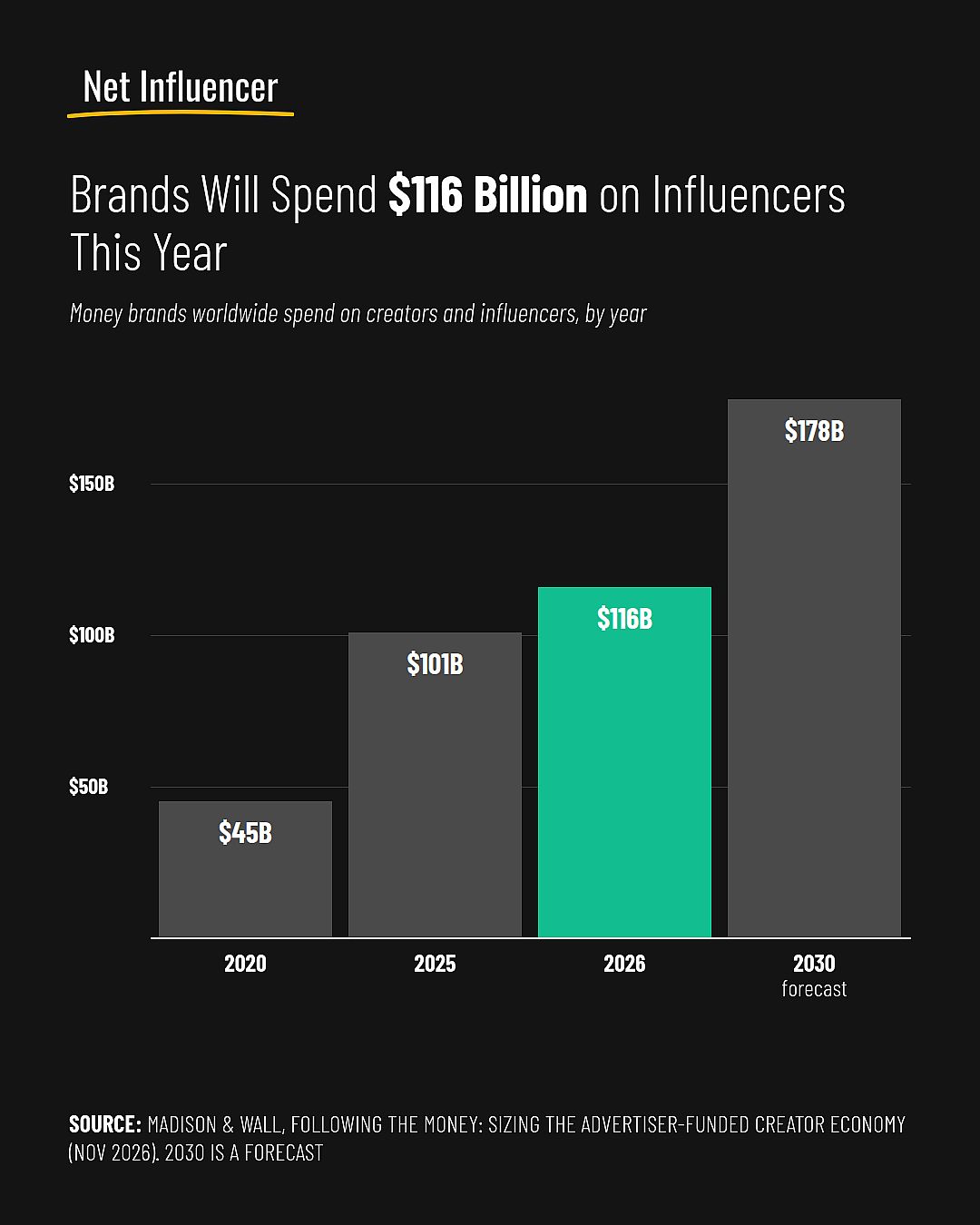
Creator spending has grown 18% a year on average over the past five years, compared with 12% for the advertising industry as a whole. Madison & Wall expects creator spending to keep growing about twice as fast as advertising through 2030, at 12% a year against 6%.
The largest share of the money buys paid ads. About $52 billion, or 44% of the 2026 total, pays to run creator videos as paid social ads or to boost creators’ posts beyond their own followers. Another $33 billion pays creators to reach their own audiences through sponsored posts, podcast reads and brand ambassador deals. Brands will spend $14 billion paying creators to make videos that the brands then run on their own accounts, websites and ads. That category is the fastest growing, rising about 20% a year since 2020. Agencies and software platforms keep about $9 billion, and events, product gifting and licensing deals account for the remaining $8 billion.
A single creator deal often pays for more than one of those things. “We don’t see influencer as a creative budget line or a media budget line,” Marcus Willis, CEO of the Melbourne agency Kill Boring Dead, told Net Influencer. “They’re part creative, they’re part media.”
The United States accounts for 43% of global creator spending, or about $43 billion in 2025 by Net Influencer’s calculation from the report’s figures. That share is higher than the country’s roughly 35% share of global advertising. India is the fastest-growing major market, with spending expected to rise 20% in 2026, while Germany and France trail the global average.
Brands are paying for influencers with TV money
Creator budgets are growing faster than advertising because brands are moving money out of other channels. “There’s just been this massive move of advertising dollars from TV into the creator economy,” Zach Blume, co-founder and president of the content studio Portal A, told Net Influencer. “It started moving from TV into digital, like paid digital, and now it’s moving from TV and from paid digital into creators.”
Large, established brands with big television, print, radio and billboard budgets are the most likely to pull money from those channels, according to the report. Some of that money still runs on TV, with creators in the ads. “Even their linear TV budgets, their CTV budgets, their display ads are leveraging creators more and more,” said Scott Sutton, CEO of the influencer marketing company Later.
Paid social and search budgets are also moving to creators
Online-first brands with small TV budgets are moving money from paid social ads, programmatic display ads and search ads, according to the report. In product categories where search keywords are expensive, some brands are paying for creator reviews and tutorials to reach shoppers who are ready to buy.
Search budgets have been slower to move because search ads are easier to measure, Sutton told Net Influencer. “If I can go and say my Google Ad spend, I spent a dollar and I drove $1.50, it’s better for them for job security potentially than if they spent a dollar in creator, they actually made three, but they have no way to prove it.”
Ad agencies are losing production work to creators
The third source of money is creative production. Brands that once paid an ad agency or production company for a small number of polished ads now hire several creators to produce dozens of versions for each platform at a lower cost per video. The report links that change to slower growth at some traditional creative agencies, which now compete with creators and AI production tools for the same budgets.
“Creators are now the new creative production house,” Andy Cloyd, co-founder and CEO of Superfiliate, which runs affiliate and influencer programs for brands, told Net Influencer. “They’re creating content for brands to test across different personas, demographics, different audiences. They are now the way that brands test.”
Why estimates of the creator economy differ
Estimates of the creator economy’s size vary widely because researchers count different money. Goldman Sachs Research estimated the creator economy at about $250 billion in 2023 and projected it could reach $480 billion by 2027, a figure that includes brand deals as well as platform ad revenue sharing, subscriptions and donations from fans. The Interactive Advertising Bureau measures what U.S. brands spend on creator partnerships and on paid ads that boost creator content, and it expects U.S. creator ad spending to reach $44 billion in 2026. Madison & Wall counts a wider range of marketer spending, including agency and software fees, product gifting, events and licensing deals. That puts U.S. spending at about $43 billion in 2025, compared with the IAB’s $37 billion for the same year.
Madison & Wall plans a second report on the problems brands face as they try to spend more on creators, including slow contracting, inconsistent pricing and limited measurement. For now, the report shows where the money is coming from: brands are paying for influencer campaigns largely by spending less on TV, search ads and traditional ad production.
This story was produced by Net Influencer and reviewed and distributed by Stacker.